
If you are new to cricket or the Indian Premier League (IPL), you may have heard commentators repeatedly mention the Powerplay during the opening overs of a match. But what exactly does Powerplay mean, and why is it so important in T20 cricket?
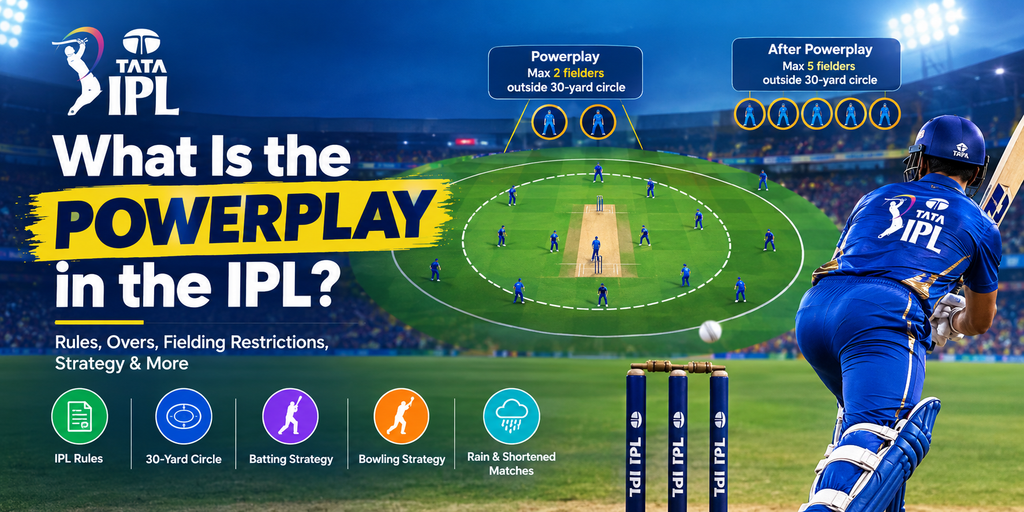
The Powerplay in the IPL is a special period at the beginning of an innings when fielding restrictions are applied. In a normal uninterrupted IPL innings, the Powerplay covers the first six overs. During these overs, a maximum of two fielders can be positioned outside the 30-yard fielding restriction area at the instant of delivery. From the seventh over onward, the normal non-Powerplay fielding restriction allows up to five fielders outside that area.
These restrictions are designed to create opportunities for attacking batting while also giving bowlers a chance to take early wickets with the new ball. As a result, the first six overs can have a major influence on the direction of an IPL match.
In this guide, we will explain what is the Powerplay in the IPL, how IPL Powerplay rules work, how many overs are included, what the 30-yard circle means, how batting and bowling strategies change, and what happens when rain reduces the length of an innings.
What Is the Powerplay in the IPL?
The simplest answer to “What is the Powerplay in the IPL?” is that it is the first six overs of a normal uninterrupted innings during which special fielding restrictions apply.
According to the current IPL playing conditions, these additional fielding restrictions apply to the first six overs of each innings in an uninterrupted match. During the Powerplay, no more than two fielders can be outside the designated fielding restriction area when the ball is delivered.
The Powerplay is therefore not a separate type of over or a special scoring period. It is primarily a fielding restriction period.
For example, imagine that Team A wins the toss and bats first. During overs 1, 2, 3, 4, 5 and 6, the fielding team has to follow Powerplay restrictions. Once the sixth over is completed, the Powerplay ends and the fielding captain can place more fielders outside the circle.
This creates a tactical difference between the opening six overs and the rest of the innings.
How Many Overs Is the Powerplay in the IPL?
In a normal 20-over IPL innings, the Powerplay lasts for six overs.
Since a standard over consists of six valid deliveries, six Powerplay overs normally contain 36 valid deliveries. However, wides and no-balls do not count as valid balls toward completion of an over, so the actual number of deliveries bowled can be higher than 36.
IPL Powerplay at a Glance
| Feature | Rule |
|---|---|
| Standard Powerplay | First 6 overs |
| Valid deliveries | 36 |
| Fielders outside restriction area | Maximum 2 |
| Non-Powerplay fielders outside | Maximum 5 |
| Main purpose | Fielding restrictions |
| Standard 20-over innings | 6 Powerplay overs |
The key point is that six overs is the standard Powerplay length, not six minutes or a fixed number of physical deliveries regardless of wides and no-balls.
When Does the Powerplay Start and End?
The Powerplay begins with the first over of the innings.
In a normal 20-over match:
- Over 1 = Powerplay
- Over 2 = Powerplay
- Over 3 = Powerplay
- Over 4 = Powerplay
- Over 5 = Powerplay
- Over 6 = Powerplay
- Over 7 onward = Non-Powerplay
Once the sixth over is completed, the special Powerplay fielding restrictions finish.
This transition is important because the captain of the fielding team can then move additional fielders outside the 30-yard restriction area. The change can significantly reduce the number of easy boundary-scoring opportunities available to the batting team.
IPL Powerplay Rules Explained
Understanding the IPL Powerplay rules is relatively simple once you know the basic fielding restriction.
Six-Overs Powerplay Rule
In an uninterrupted match, the Powerplay applies to the first six overs of each innings.
During this period, the fielding captain has fewer options for placing fielders on the boundary.
That restriction is what creates many of the attacking opportunities associated with Powerplay batting.
The Two-Fielder Rule
The most important Powerplay rule is the number of fielders allowed outside the fielding restriction area.
During the Powerplay, no more than two fielders may be outside the restriction area at the instant the ball is delivered. During non-Powerplay overs, that number increases to five.
This means that the fielding team cannot simply place several players around the boundary to stop fours and sixes.
Instead, the captain must decide which areas to protect and which areas to leave open.
What Is the 30-Yard Circle?
When people talk about the 30-yard circle in IPL cricket, they are referring to the fielding restriction area around the pitch.
The current IPL playing conditions describe two semi-circles centered on the middle stump at each end of the pitch, with a radius of 30 yards, or 27.43 metres. These areas are connected by parallel lines.
The restriction is based on whether a fielder is inside or outside this designated area at the instant the ball is delivered.
For a new cricket viewer, the easiest way to remember it is:
Powerplay = fewer fielders allowed outside the circle.
Powerplay Fielding Restrictions in the IPL
The IPL Powerplay fielding restrictions are designed to create a balance between attacking batting and strategic bowling.
During the first six overs:
- Maximum two fielders can be outside the restriction area.
- The remaining fielders must be positioned within the permitted area, subject to the other fielding laws.
- The bowling captain must carefully decide where to use the available outside-circle positions.
After the Powerplay:
- Up to five fielders can be outside the restriction area.
- The captain has greater freedom to protect the boundary.
- Batters often have fewer obvious gaps to target.
This difference is one of the main reasons the first six overs are tactically important.
Why Does the IPL Have a Powerplay?
The Powerplay is important because it changes the balance between the batter and the fielding team.
Without fielding restrictions, a captain could place several fielders on the boundary from the beginning of an innings. That could make aggressive batting considerably more difficult.
The Powerplay prevents that by limiting the number of fielders outside the restriction area.
Encouraging Aggressive Batting
With fewer boundary fielders, batters can identify gaps and attack them.
A well-timed shot through cover, point, square leg or midwicket can potentially travel into an area without a deep fielder.
This encourages opening batters to take advantage of the field.
Creating an Exciting Start
T20 cricket is built around fast scoring and short innings.
The Powerplay can produce:
- Early boundaries
- Sixes
- Fast scoring rates
- Early wickets
- Attacking field placements
- Momentum shifts
This is why commentators often describe the first six overs as an important phase of the innings.
Balancing Bat and Ball
It would be incorrect to assume that Powerplay automatically favors the batting team.
The batting side has fielding restrictions to exploit, but bowlers have the new ball and can attack the top order.
Swing, seam movement, pace and bounce can make the first few overs challenging for batters.
How Does the Powerplay Affect Batting?
The Powerplay has a major influence on IPL Powerplay batting strategy.
Opening batters know that the field is restricted, so they may look for opportunities to score quickly.
Why Do Opening Batters Attack?
There are several reasons.
First, fewer fielders are available outside the circle.
Second, the new ball can come onto the bat nicely under some conditions.
Third, a strong start can create momentum for the middle and death overs.
However, aggressive batting always involves risk.
A batter attempting to hit every delivery can give the bowling team an early wicket.
Therefore, successful Powerplay batting is usually about controlled aggression, rather than blindly attacking every ball.
Should Batters Always Attack During Powerplay?
No.
A team may choose to attack aggressively, but the correct approach depends on:
- Pitch conditions
- Bowling quality
- Match situation
- Required run rate
- Target
- Wickets available
- Batter’s strengths
For example, if an opening pair faces excellent swing bowling, surviving the first few overs may be more important than attempting a boundary from every delivery.
On a flat batting pitch, however, a team may decide to maximize the fielding restrictions.
Powerplay Batting Strategy
A successful Powerplay batting strategy can involve several elements.
1. Finding Gaps
Batters can target areas where there is no boundary fielder.
2. Rotating the Strike
Singles and twos prevent bowlers from building pressure through repeated dot balls.
3. Attacking Loose Deliveries
A wide, short, overpitched or otherwise hittable delivery can be punished.
4. Choosing the Right Bowler to Attack
Batters may identify a particular bowler whose style matches their strengths.
5. Protecting Wickets
Scoring quickly is useful, but losing multiple wickets can cancel out the advantage of a fast start.
This is why the best Powerplay approach often combines boundary hitting, strike rotation and sensible risk management.
How Does the Powerplay Affect Bowling?
The Powerplay also creates opportunities for the bowling team.
At first glance, having only two fielders outside the circle appears difficult for bowlers. However, the opening overs also give bowlers access to a relatively new ball and an attacking field.
Challenges for Fast Bowlers
Fast bowlers have less boundary protection, so inaccurate deliveries can be expensive.
A ball that normally might result in a single could potentially reach the boundary if the appropriate deep fielder is unavailable.
Therefore, accuracy is extremely important.
Why Can the Powerplay Help Bowlers?
The new ball can sometimes move through the air or off the pitch.
This can allow fast bowlers to attack the edges of the bat.
The bowling captain may also place catching fielders in positions such as slip or gully instead of immediately spreading the field.
Importance of Early Wickets
Removing an opening batter early can prevent a dangerous partnership from developing.
A wicket can also force a new batter to spend time adjusting to the conditions.
This is why Powerplay wickets in IPL matches can be extremely valuable.
Can Spinners Bowl During the Powerplay in IPL?
Yes.
A common misconception is that only fast bowlers can bowl during the Powerplay.
Spinners are allowed to bowl during the first six overs.
The decision to use spin depends on the captain, pitch, batter match-up and conditions.
An off-spinner or leg-spinner may be introduced if the captain believes the batter could struggle against that type of bowling.
The IPL has also featured spinners who have specifically embraced the challenge of bowling during the Powerplay. For example, Washington Sundar has previously discussed the challenge of bowling when only two fielders can be outside the circle.
Powerplay Strategy for Bowling Teams
A bowling captain may use several strategies during the Powerplay.
Attack the Top Order
The first objective may be to remove dangerous openers.
Use the New Ball
Fast bowlers can attempt to exploit movement and bounce.
Create Catching Opportunities
Instead of placing every available player on the boundary, captains can use attacking catching positions.
Bowl to the Batter’s Weakness
A bowler may repeatedly target an area where the batter has difficulty scoring.
Build Pressure With Dot Balls
A series of dot balls can increase pressure on the batter.
Eventually, the batter may attempt a risky shot to break the pressure.
How Captains Use the Powerplay Differently
The Powerplay is also a test of captaincy.
A batting captain may select aggressive opening batters specifically because of the fielding restrictions.
A bowling captain, meanwhile, has to balance attacking field placements with boundary protection.
The captain must consider:
- Which bowler should open?
- Should a spinner be introduced?
- Where should the two outside-circle fielders stand?
- Should a slip fielder be used?
- Which batter should be targeted?
- When should the field change?
These decisions can affect the momentum of the innings.
What Happens After the Powerplay?
Once the sixth over ends, the Powerplay is over in a standard uninterrupted innings.
From the seventh over onward, the non-Powerplay fielding restrictions apply.
The IPL playing conditions allow up to five fielders outside the fielding restriction area during non-Powerplay overs.
This gives the captain more opportunities to protect boundaries.
The difference can be noticeable immediately.
During the Powerplay, a batter might find a large gap in the deep. After the Powerplay, a captain can place another boundary fielder in that area.
This is one reason batting strategies often change after six overs.
What Is a Good Powerplay Score in the IPL?
There is no single Powerplay score that can always be called good.
A score must be considered in context.
For example, a Powerplay total that looks modest on a difficult pitch could be valuable, while the same score might be disappointing on a flat batting surface.
Factors include:
- Pitch conditions
- Venue
- Bowling attack
- Match situation
- Target
- Wickets lost
- Batting first or second
Therefore, instead of asking only “What is the average IPL Powerplay score?”, it is useful to examine the scoring rate, wickets and match conditions together.
A team scoring quickly without losing wickets can put itself in a strong position for the middle and death overs.
Can a Team Score More Runs During the Powerplay?
There is no fixed run limit during the Powerplay.
A batting team can score as many runs as it is capable of scoring through boundaries, running between the wickets and extras.
The Powerplay only introduces fielding restrictions. It does not place a maximum limit on the number of runs a team can score.
That is why IPL Powerplay scores can vary dramatically from match to match.
What Is a Powerplay Wicket?
A Powerplay wicket simply refers to a wicket taken during the Powerplay.
It can be especially valuable because the batting side is usually trying to score quickly during this phase.
Suppose an opening batter starts with several boundaries. If the bowler dismisses that batter before the sixth over ends, the bowling team may stop the batting side from building an even bigger Powerplay total.
At the same time, the batting team may still recover if another batter continues scoring.
Therefore, a Powerplay wicket does not automatically determine the result of a match.
Powerplay in Shortened or Rain-Affected IPL Matches
What happens if rain interrupts an IPL match?
The Powerplay does not necessarily remain at six overs if the innings is shortened.
The current IPL playing conditions provide adjusted Powerplay periods when the number of overs available to a batting team is reduced.
For example, the current 2026 playing conditions include adjusted restrictions for shorter innings.
| Total Overs in Innings | Powerplay |
|---|---|
| 5 | 1.3 overs |
| 6 | 1.5 overs |
| 7 | 2.1 overs |
| 8 | 2.2 overs |
| 9 | 2.4 overs |
| 10 | 3 overs |
| 11 | 3.2 overs |
| 12 | 3.4 overs |
| 13 | 3.5 overs |
| 14 | 4.1 overs |
| 15 | 4.3 overs |
| 16 | 4.5 overs |
| 17 | 5.1 overs |
| 18 | 5.2 overs |
| 19 | 5.4 overs |
| 20 | 6 overs |
One important cricket detail is that “1.3 overs” means one completed over plus three legal deliveries, not 1.3 decimal overs.
The adjusted Powerplay table applies when the number of overs available to the batting side is reduced.
Powerplay and the DLS Method
Rain-affected matches can involve revised innings lengths under the applicable playing conditions and DLS calculations.
When the available playing time is reduced, teams may receive fewer overs.
That can also mean a shorter Powerplay.
This creates an interesting tactical situation because a batting team may have fewer total overs but still need to make maximum use of its restricted-fielding period.
A team in a shortened match may therefore adopt a much more aggressive Powerplay approach.
Powerplay vs Non-Powerplay Overs
The biggest difference between Powerplay and non-Powerplay overs is the number of fielders allowed outside the fielding restriction area.
| Feature | Powerplay | Non-Powerplay |
|---|---|---|
| Standard overs | 1–6 | 7–20 |
| Outside-circle limit | Maximum 2 | Maximum 5 |
| Batting opportunities | More open field | More boundary protection |
| Fielding flexibility | Restricted | Greater |
| Typical batting approach | Often aggressive | More flexible |
| Tactical focus | Fast start and wickets | Building innings or controlling scoring |
These fielding restrictions are specifically defined in the IPL playing conditions.
Powerplay vs Middle Overs vs Death Overs
A T20 innings is commonly viewed in three broad phases.
Powerplay: Overs 1–6
The Powerplay features the strongest fielding restrictions.
Batters may attack because fewer fielders can be positioned outside the circle.
Bowlers, meanwhile, attempt to use the new ball and take early wickets.
Middle Overs: Approximately 7–15
After the Powerplay, captains have more freedom with boundary fielders.
Batters often focus on strike rotation, partnerships and selecting the right moments to attack.
Spinners can also become an important tactical option.
Death Overs: Approximately 16–20
The final overs are usually associated with aggressive batting and boundary hitting.
The batting team often tries to maximize the remaining deliveries, while bowlers use variations such as yorkers, slower balls and changes of pace.
The field is also more spread because the non-Powerplay fielding restrictions permit more fielders outside the restriction area.
A Simple IPL Powerplay Example for Beginners
Imagine Team A begins an IPL innings.
Over 1
The Powerplay begins.
Only two fielders can be outside the restriction area at the instant of delivery.
Overs 2–5
The same Powerplay fielding restriction continues.
The batting team can try to exploit gaps created by the limited number of deep fielders.
Over 6
The final Powerplay over is bowled.
Both teams know that the fielding restriction will end once this over is completed.
Over 7
The Powerplay is finished.
The bowling captain can now have up to five fielders outside the restriction area.
This simple example shows why the seventh over can represent a tactical turning point.
Common Misconceptions About IPL Powerplay
Myth 1: Powerplay Means Batters Cannot Get Out
False.
Normal dismissal rules continue during the Powerplay.
A batter can be bowled, caught, LBW, run out or dismissed through other applicable methods.
Myth 2: Only Fast Bowlers Can Bowl in Powerplay
False.
Spinners are allowed to bowl during the Powerplay.
Myth 3: Exactly Two Fielders Must Be Outside the Circle
Not quite.
The rule says no more than two fielders can be outside the restriction area at the instant of delivery.
That means a captain does not have to place exactly two fielders outside.
Myth 4: Powerplay Always Lasts Six Overs
Not in every match situation.
Six overs is the standard Powerplay in an uninterrupted 20-over innings. If the innings is reduced, the Powerplay can also be reduced according to the applicable table.
Myth 5: Powerplay Guarantees a High Score
No.
A team can still struggle during the Powerplay.
Excellent bowling, difficult pitch conditions or early wickets can restrict the scoring rate.
Famous Powerplay Performances in IPL
Powerplay statistics often provide a useful way to understand how dramatically the first six overs can influence a match.
For example, in a 2026 IPL match between Rajasthan Royals and Chennai Super Kings, Rajasthan raced to 74/0 during the Powerplay. The official IPL match report highlighted the aggressive start, including Vaibhav Sooryavanshi’s rapid scoring.
This is a good example of how a batting team can use the fielding restrictions to establish momentum early.
Powerplay bowling performances can be equally important. An effective bowler can prevent boundaries, create dot-ball pressure and take wickets before the batting team settles.
Therefore, when comparing teams or individual players, Powerplay statistics can reveal more than just the final score.
How to Improve Powerplay Batting
For players learning cricket, Powerplay batting is about understanding both opportunity and risk.
Watch the Field
Before playing an attacking shot, identify where the fielders are positioned.
Attack the Right Balls
Not every delivery needs to be hit.
Wait for deliveries in your scoring areas.
Rotate Strike
A single can be valuable because it keeps the scoreboard moving.
Avoid Unnecessary Risks
A boundary is useful, but losing a wicket can be more damaging.
Communicate With Your Partner
Opening partnerships require constant communication about running and match situation.
How to Improve Powerplay Bowling
Bowlers can also use several principles during the first six overs.
Maintain Accuracy
With fewer boundary fielders, poor deliveries can be punished.
Use the Conditions
If the ball is moving, bowlers should attempt to exploit that movement.
Attack the Stumps
Bowling at the stumps can bring bowled and LBW dismissals into play.
Study the Batter
A bowler should identify where the batter is comfortable and uncomfortable.
Build Pressure
Several dot balls can create pressure even without an immediate wicket.
Why Is Powerplay Important in IPL?
The answer to “Why is Powerplay important in IPL?” comes down to momentum and fielding restrictions.
The batting team receives an opportunity to attack a relatively restricted field.
The bowling team receives an opportunity to attack with the new ball and remove important top-order batters.
Captains have to make decisions quickly.
A successful Powerplay can provide:
- A strong platform for the innings
- Early wickets for the bowling side
- Momentum
- A high scoring rate
- Pressure on the opposition
However, Powerplay performance is only one part of a T20 match.
A team can recover from a poor Powerplay, and a team can also lose after an excellent Powerplay.
Frequently Asked Questions About IPL Powerplay
What is the Powerplay in the IPL?
The Powerplay is the first six overs of a normal uninterrupted IPL innings when special fielding restrictions apply. No more than two fielders can be outside the fielding restriction area at the instant of delivery.
How many overs is Powerplay in IPL?
The standard IPL Powerplay is six overs.
How many fielders can be outside the circle during Powerplay?
A maximum of two fielders can be outside the fielding restriction area during the Powerplay at the instant of delivery.
How many fielders can be outside the circle after Powerplay?
During non-Powerplay overs, up to five fielders can be outside the fielding restriction area.
Can spinners bowl during Powerplay in IPL?
Yes. Spinners can bowl during the Powerplay.
What is the 30-yard circle in IPL?
It is the fielding restriction area defined around the pitch. The current IPL playing conditions specify semi-circles with a radius of 30 yards, or 27.43 metres.
What happens after the Powerplay in IPL?
After the sixth over in a normal 20-over innings, the Powerplay ends and non-Powerplay fielding restrictions apply.
Does Powerplay change in a rain-affected IPL match?
It can. If the number of overs available to a batting team is reduced, the Powerplay can also be reduced according to the applicable IPL playing conditions.
What happens if fielders violate Powerplay restrictions?
A violation of the applicable fielding restriction can result in a No ball under the IPL playing conditions.
What is a good Powerplay score in IPL?
There is no universal number. A good Powerplay score depends on the pitch, venue, bowling attack, target, wickets lost and match situation.
Can a team score sixes during Powerplay?
Yes. Batters can hit boundaries and sixes during the Powerplay. There is no special limit on the number of runs that can be scored.
Why do IPL teams attack during Powerplay?
The limited number of fielders outside the circle can create gaps that batters can target.
What is the difference between Powerplay and death overs?
The Powerplay is the opening phase with special fielding restrictions, while death overs refer broadly to the final overs of an innings when teams usually focus heavily on maximizing the final scoring opportunities.
Final Thoughts
So, what is the Powerplay in the IPL? In simple terms, it is the opening six-over phase of a normal uninterrupted innings where the fielding team faces special restrictions.
During these six overs, no more than two fielders can be outside the designated fielding restriction area. Once the Powerplay ends, up to five fielders can be positioned outside that area during non-Powerplay overs.
This simple rule has a major tactical effect on T20 cricket.
Batters can look for gaps and attack the restricted field. Bowlers can use the new ball to search for wickets. Captains must decide whether to attack with catching fielders or protect particular scoring areas.
The Powerplay therefore combines batting strategy, bowling strategy, field placement and captaincy into one of the most important phases of an IPL innings.
For readers who want to explore the rules in more detail, the official IPL playing conditions are a useful external reference: IPL 2026 Match Playing Conditions
Whether you are a new cricket fan or a regular IPL viewer, understanding the Powerplay makes it much easier to follow why teams attack differently in the first six overs and why a strong start—or an early collapse—can change the momentum of an entire match.